EnergyFlex could show people exactly how ready their home was for renewables, and almost nobody was getting that far.
The platform gives users visibility over their energy readiness and their consumption habits — the information you need before spending money on solar, a battery or a switch of plan.
The data was rich and the intent was right. Adoption was the problem, and it was being lost before anyone reached the value.
The award-winning app was designed by EnergyFlex and CodeFish Studio together.
Four separate problems were compounding, and every one of them showed up as the same number falling.
A platform built on rich data is only as useful as the clarity it offers the person reading it. EnergyFlex had the depth but not the translation, so an average user opened it, could not see what to do next, and left.
Onboarding made that worse rather than better. Consumer Data Rights obligations meant users had to be taken through consent and data-sharing steps before the platform could show them anything — necessary, non-negotiable, and friction at exactly the point where people are least invested.
The audience had also moved underneath the product. EnergyFlex was designed for corporate customers and now needed to serve individuals as well, two groups who arrive with different questions and very different tolerance for complexity.
And it all had to happen quickly. Investors were watching for clear ROI milestones, which put the design work under a delivery clock as well as a quality bar.
A complex user journey
Rich data, but not enough clarity for an average user to engage with it.
Regulatory barriers
Consumer Data Rights compliance added friction to onboarding, before any value was visible.
An audience shift
Built for corporations, now needing to serve individuals and businesses equally well.
Investor expectations
Rapid execution against clear ROI milestones, to hold stakeholder confidence.
We rebuilt onboarding around what the user gets, not around what the platform needs from them.
The consent steps could not be removed, so we changed what they were asking for. Restructured onboarding leads with the value of the data exchange — what you get back for sharing — which turns a compliance gate into the first useful thing the product does.
Alongside that we worked on the roadmap itself. Features were run through MOSCOW prioritisation so sprints were structured around high-impact work rather than whatever was next on the list, which is what let EnergyFlex hit investor milestones without spending more to get there.
We also changed how we work to suit them. CodeFish normally runs a waterfall process; here we adapted to Agile sprint cycles to match investor-driven timelines, because the delivery rhythm was part of the client's problem rather than an internal preference.
Underneath it we put in a structured UI system. That cut design debt and rework, and gave a team spread across several development phases a single source to build from instead of re-deciding the same details repeatedly.
User-centric onboarding
Restructured to lead with the value of the data exchange, making participation easier.
A clarified roadmap
MOSCOW prioritisation, with sprints structured around high-impact deliverables.
Hybrid delivery
We moved from our usual waterfall process to Agile sprints to match investor timelines.
Scalable UI systems
A structured design process that cut design debt and improved collaboration across phases.
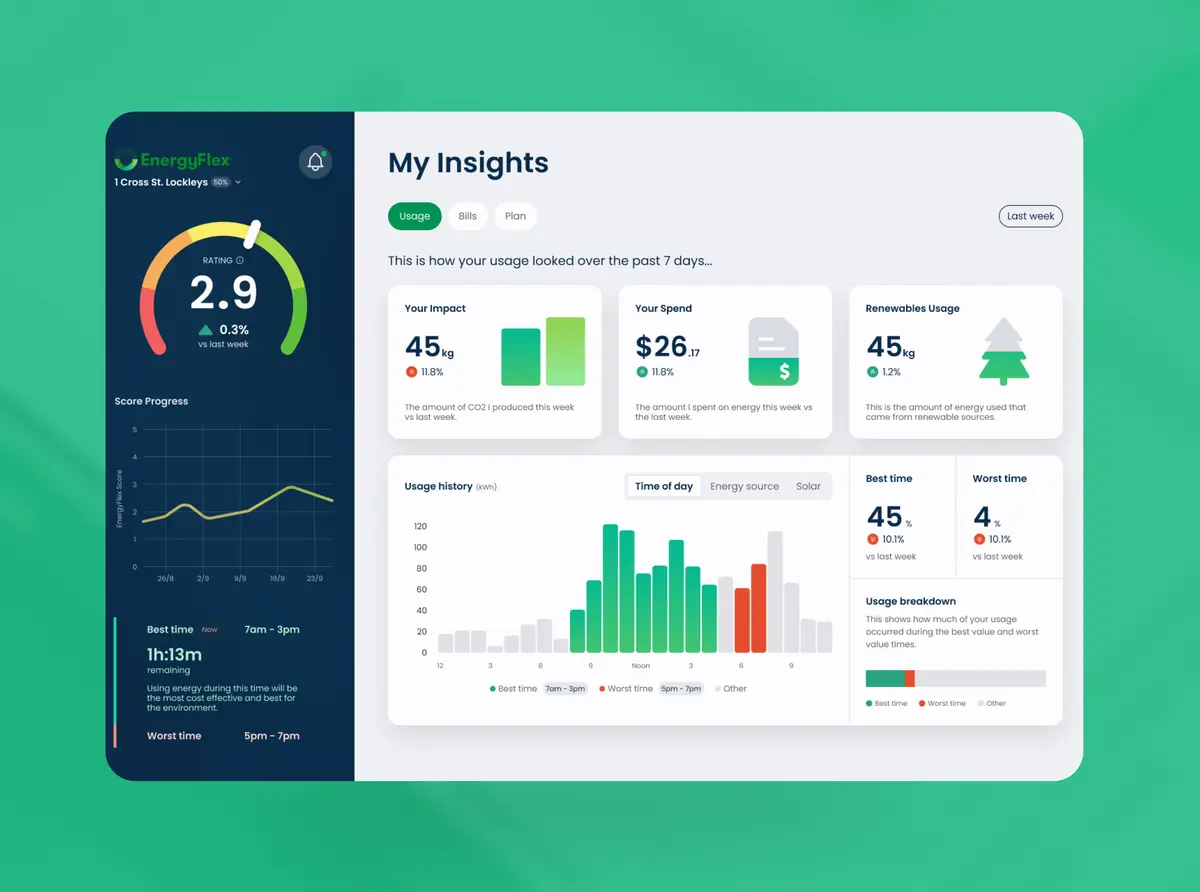
A more engaging platform that meets its regulatory obligations and did not cost more to get there.
The intuitive interface closes the gap between complex data and usability. Users can now read their own energy position without interpreting it first, which is what drives the engagement the platform depends on.
The onboarding framework satisfies Consumer Data Rights obligations while staying usable — compliance handled inside the experience rather than bolted in front of it.
Streamlined execution accelerated development cycles and helped EnergyFlex meet key milestones without additional capital expenditure, which matters when investor confidence is tied to hitting dates.
EnergyFlex's development team, led by Momar Hughes, built the platform and keeps refining it. The Good Design Award jury called the result "a comprehensive digital service that empowers consumers to participate actively in the energy transition."
With a clear design and development blueprint in place, EnergyFlex is positioned to refine and expand the platform from here rather than rebuild it — the difference between a project that ends and one that keeps returning.
What does EnergyFlex deliver today?
Stronger engagement
An interface that bridges complex data and everyday usability.
CDR compliant onboarding
Regulatory obligations met without losing the user partway through.
No additional capex
Milestones met through faster cycles rather than more spend.
Ready to expand
A design and development blueprint the platform can grow on.

If you're building a data-driven product and need a partner that understands both strategy and execution, CodeFish Studio is the team to call.